News
Solar panels for drinking water
Renewable energy as an innovative solution
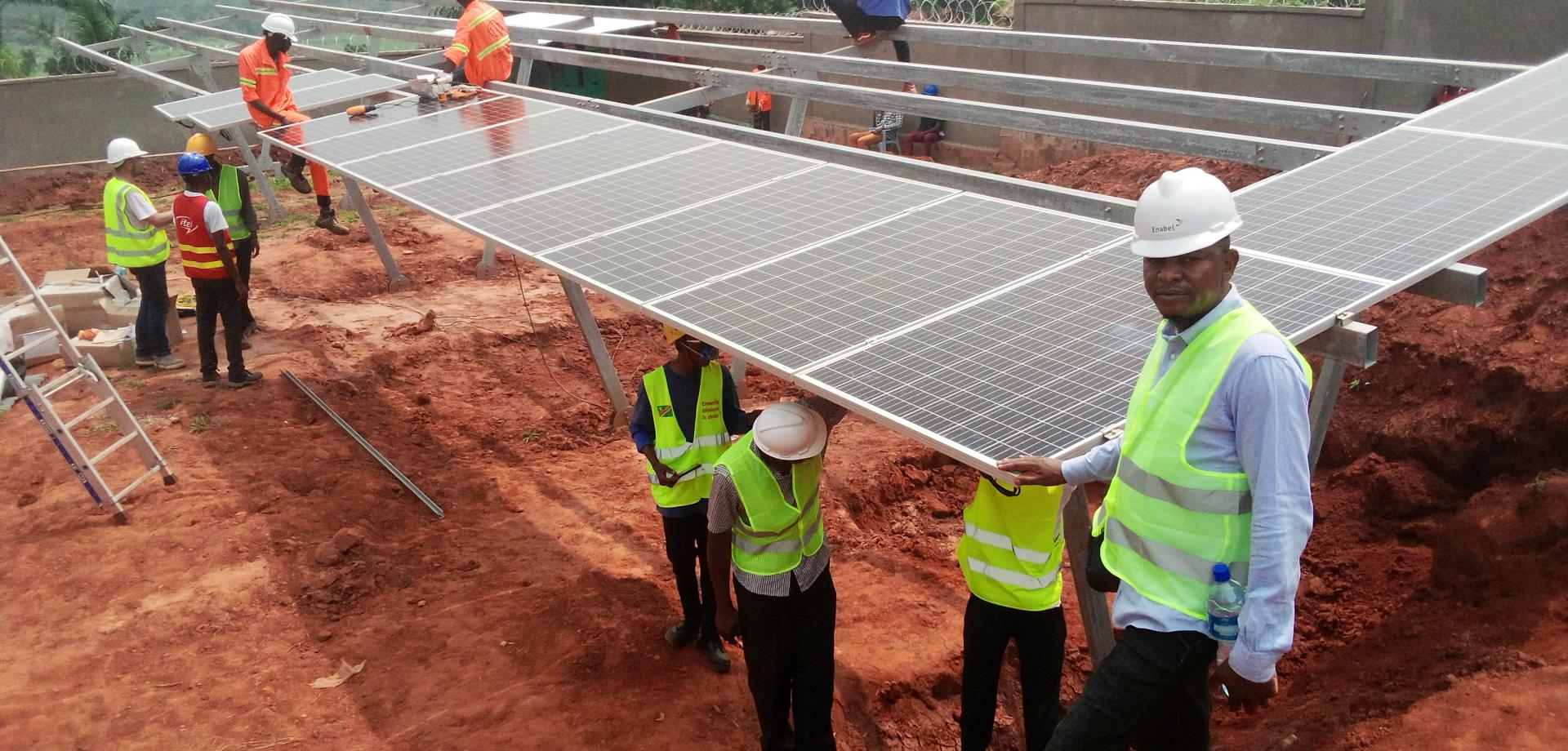
In the Democratic Republic of Congo, most households struggle to access a correct source of drinking water. But how do you solve this when there is no electricity either? Enabel tackles the problem together with local partners.
Congo is a huge country with tremendous logistical challenges. Large parts of the country lack basic infrastructure such as roads, water supply or electricity. The difficult accessibility of some areas makes it even more challenging to set up such infrastructure. Only two per cent of the rural population has access to electricity, and that is not going to improve quickly because the electrification of the country is proceeding extremely slowly.
Furthermore, 75% of the population has no access to safe drinking water, and this in a country with enormous water potential. The country ranks 46th out of 54 countries in Africa in terms of access to drinking water.
In a country plagued by epidemics such as Ebola, cholera and Covid-19, it is essential to improve the distribution of clean water.
It is in this context that the Belgian development agency, through its water programme, aims to ensure access to drinking water for 600,000 people in three different provinces.
But without electricity, there is no drinking water…
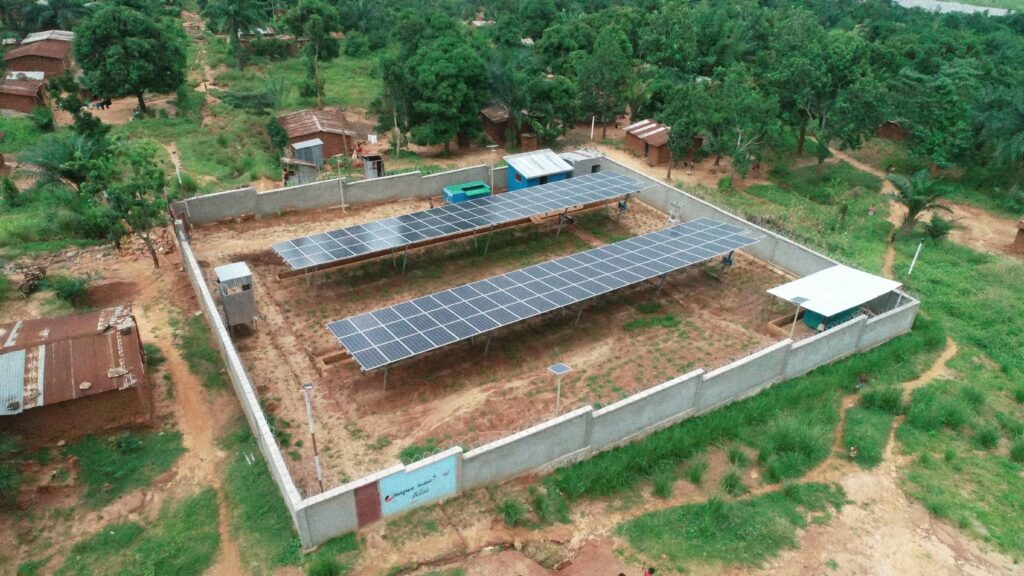
A photovoltaic park to generate water
In the provinces of Kasaï-Oriental and Maniema, where electricity supply is also problematic, Enabel is working with the local authorities to provide some 480,000 people with drinking water through solar energy.
Energy is needed to pump the water from underground to the water towers. Since electricity networks are virtually non-existent and generators involve high fuel costs, the agency decided to rely on off-grid solar energy.
Solar fields with a powers reaching 44 kWp provide the necessary energy during the day to pump the water to the water towers. The system does not require a battery, as the tank acts as an energy storage mechanism, but it remains a hybrid system with a back-up generator for periods of high consumption and/or a lack of sunlight.
The renewable energy-based system aims to reduce costs and make drinking water more affordable for everyone. Lucas Cornet – Engineer Project Manager
On average, between 100 m³ and 250 m³ of water are pumped by each water system every day.
The pump starts as soon as the sun is high enough, usually around 9 or 10 am, and works until 3 or 4 pm, depending on the season. The pumping is progressive, in accordance with the available energy. In the end, the water flow is proportional to the solar radiation.
Thanks to this system, the water towers placed at a sufficient altitude ensure gravity distribution to the tapstands and the few private connections. To ensure quality control, the water is purified with chlorine produced locally by the associations of users of drinking water networks (ASUREP). They use small devices ensuring the hydrolysis of the salt bought in bulk at the market. These kits are also powered by solar energy. The chlorine concentration is adjusted in real time by a dosing pump, proportionally to the incoming water flow. The small dosing pumps are also powered by the photovoltaic system.
The price of water
Drinking water remains expensive for households with an average purchasing power of less than two dollars a day. But by investing in well-designed renewable energy systems, the price of water can be reduced by about 25 to 40% compared to pumping by generators. This will gradually make water more accessible and affordable for everyone!
More updates and resources
eee
Maecenas id luctus elit, eget dignissim mauris. Morbi rutrum tincidunt purus, ac dignissim tortor varius in. Praesent ut nibh cursus, bibendum leo quis, tristique ligula. Nam sollicitudin quam et est elementum tincidunt. Morbi id diam eu nisi consectetur placerat.
Read more
01 September 2025
This a Junior Post (including in the all news page)
Maecenas id luctus elit, eget dignissim mauris. Morbi rutrum tincidunt purus, ac dignissim tortor varius in. Praesent ut nibh cursus, bibendum leo quis, tristique ligula. Nam sollicitudin quam et est elementum tincidunt. Morbi id diam eu nisi consectetur placerat.
Read more
This is a Junior Post (excluded from news)
Maecenas id luctus elit, eget dignissim mauris. Morbi rutrum tincidunt purus, ac dignissim tortor varius in. Praesent ut nibh cursus, bibendum leo quis, tristique ligula. Nam sollicitudin quam et est elementum tincidunt. Morbi id diam eu nisi consectetur placerat.
Read more
Test Youtube video
Maecenas id luctus elit, eget dignissim mauris. Morbi rutrum tincidunt purus, ac dignissim tortor varius in. Praesent ut nibh cursus, bibendum leo quis, tristique ligula. Nam sollicitudin quam et est elementum tincidunt. Morbi id diam eu nisi consectetur placerat.
Read more
 Events
09 May 2022
Accessible social health protection in low-income countries
Every country in the world faces the challenge of protecting its population. But how to set up social protection? Where to start?
Read more
 News
News
30 July 2022
Quelles sont les formes d’engagement prises par les jeunes actuellement ?
Si les marches pour le climat, le mouvement #metoo et les manifestations Black Lives Matter sont des exemples récents d’engagement social où les jeunes ont pris une place prépondérante, des discours catastrophiques se font également entendre : les jeunes seraient de moins en moins intéressé·es par les questions sociales.
Read more